Students handle projects every day. You plan assignments, group tasks, research work, and practical activities. Each project needs a clear goal, a schedule, and a result. Many students feel stressed because they do not follow a simple structure. Project management skills give you that structure. These skills help you plan your work, stay organized, and finish tasks with confidence.
A project has a beginning, a middle, and an end. You create a plan. You complete tasks in order. You submit the final output on time. When you understand how to manage a project, you reduce confusion. You reduce wasted time. You avoid last minute rushing. You also improve the quality of your work. These skills support you in every degree program.
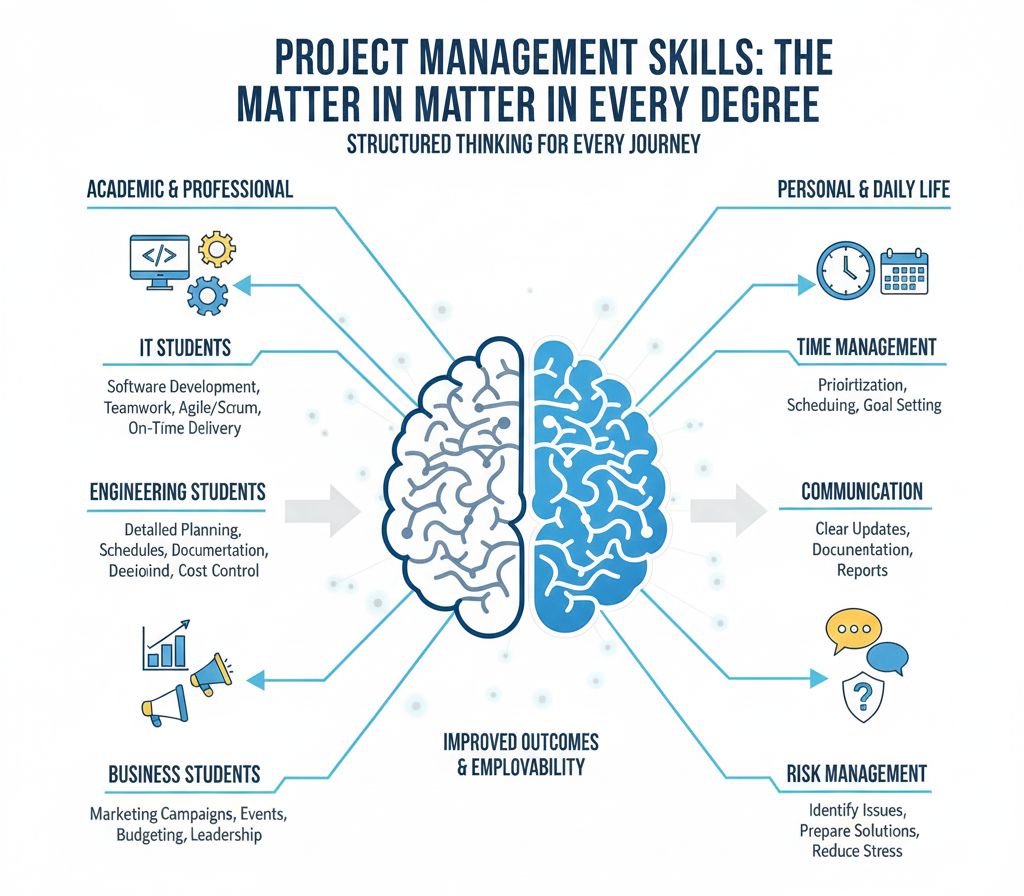
Project management helps IT students handle software development tasks. Modern software projects need teamwork. Developers, designers, and testers work as a single group. Without planning, an IT project often faces delays or unclear outcomes. One study from McKinsey reported that about 45 percent of software projects go above the planned budget and timeline because teams skip structured planning. When you understand methods like Agile or Scrum, you build your tasks in small steps. You review progress often. You update tasks based on feedback. You communicate clearly with your team. You increase the chance of delivering a working software product on time.
Engineering students deal with detailed activities. You handle drawings, schedules, material lists, and site coordination. Small planning errors lead to cost increases or safety concerns. Many engineering projects fail due to poor planning and documentation. Reports from the Construction Industry Institute show that about 25 percent of project delays link to weak task planning and poor communication between teams. When you understand simple tools like Gantt charts or Work Breakdown Structures, you break your work into steps. You know what task comes first. You understand the needed resources. You record progress in a clear format. You communicate instructions with accuracy. Project management skills help you prepare for real engineering environments where planning and reporting are daily tasks.
Business students often manage events, marketing campaigns, and research activities. Every business task needs coordination. You handle budgets, teams, and timelines. Without project management, business tasks lose direction. You face confusion, repeated work, and poor results. Many business failures link to weak planning. A report from PwC stated that only about 2.5 percent of companies finish their projects fully on target. Most issues come from unclear scope and weak scheduling. When you apply project management concepts, you stay focused. You set goals. You monitor progress. You communicate clear updates. These habits make you a stronger team member and a reliable leader.
Project management also builds useful habits for daily life. You learn to manage your time. You plan your week based on priorities. You break large goals into small steps. You make decisions with better clarity. You follow a realistic schedule. You reduce stress because you know what to do next. These skills support you during exams, internships, and professional tasks.
You also improve your communication skills. Project work forces you to share updates in clear words. You use short sentences. You explain progress without confusion. You learn to record information. You build logs, registers, and checklists. These tools help you track your work quickly. Many companies look for graduates who know how to prepare clear records and progress reports. When you practice project management early, you become more prepared for work environments that expect structured communication.
You also become better at teamwork. Many university groups face conflict because tasks are not defined. When you assign roles, everyone knows what to do. When you track progress, everyone understands the current stage. When you keep records, you avoid arguments. These habits reduce stress and improve your final output. Project management gives you simple tools to support teamwork.