In one country where I once worked, we had a Project Manager known by a very unusual nickname ‘Airport Manager’
Our project had nothing to do with airports. It was a major expressway project with bridges, interchanges, utilities and traffic diversions, the usual orchestra of complications that accompany large infrastructure works. Yet at a certain stage of the project, the Consultancy Team Leader carried a name that reminded everyone of boarding passes and departure gates.
The story behind that nickname was far more interesting than any technical drawing.
In large projects, leadership normally arrives through ceremony. There are shortlists, interviews, committee approvals, reference checks and long email trails. CVs are examined carefully. Presentation skills are evaluated. Fluency in English quietly becomes a qualification of its own.
But on this project, leadership arrived through a conversation in an airport lounge.
At that time, I was part of the consultancy team. The environment was delicate. The contractor was commercially aggressive. The employer was powerful. Political shadows quietly crossed technical discussions.
Within a short period several Consultant Project Managers were replaced. Some were removed suddenly. Others left under pressure.
For nearly three months the project continued without a formal Consultant Project Manager.
On paper everything looked normal. Progress reports were submitted. Meetings were held. Minutes were circulated.
But something invisible was missing.
Coordination became fragile. Small issues escalated quickly. Emotions crept into technical discussions. Decisions carried tension. A leadership vacuum never appears in dashboards — but you can feel it in corridors, in side conversations, and in the tone of emails.
Then something unexpected happened.
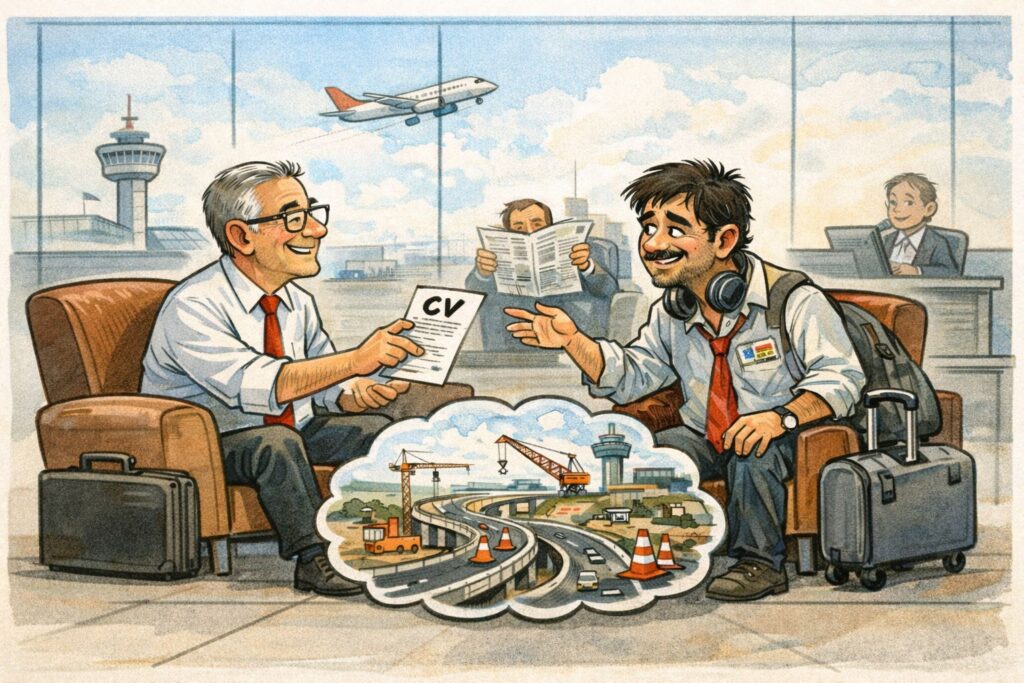
A senior director from the client organisation happened to meet a professional at an airport lounge. The man had travelled for an interview and was returning home after not being selected. The reason was simple ; his English was not considered strong enough.
In international projects, language fluency often becomes a shortcut for competence. Smooth speaking creates comfort. Accent creates confidence.
But during that casual airport conversation, the director noticed something beyond language.
He invited the man to send his CV and discuss a possible opportunity. In fact, the director had already decided to bring him to our troubled project. Perhaps he thought that something was better than nothing.
Soon afterwards the new Project Manager was formally appointed.
When the news reached us, reactions were cautious.
“Will he manage contractor negotiations?”
“This project is politically sensitive.”
“Communication is critical here.”
With little expectation from the team, the new PM arrived quietly. He kept soft music playing in his room and often hummed along while working. He did not appear tense or overly serious.
During the first few meetings he spoke very little, partly because of his language limitation. Instead, he listened. He asked a few short questions. He allowed everyone to finish before responding.
Slowly we began to understand something important.
Communication is not merely language.
It is confidence without showing off.
Firmness without raising your voice.
Emotional intelligence without becoming emotional.
And the ability to read a room before speaking in it.
He never tried to challenge the existing power balance directly. Instead, he observed quietly and understood stakeholder interests. He quickly identified who the real decision-makers were.
He understood the political environment without becoming political.
He sensed the economic pressures behind commercial claims.
He recognised environmental and social sensitivities surrounding the project.
He may never have used the term, but he was practising what we now call PESTLE awareness that is understanding the political, economic, social, technological, legal and environmental context of a project.
Within weeks the atmosphere began to change.
The contractor stopped testing limits unnecessarily.
The client reduced reactive pressure.
Our consultancy team regained its confidence.
The project did not suddenly become easy. The new PM was not particularly famous for technical brilliance. But he understood rhythm, survival and timing. Somehow, he managed the turbulence with a few simple words of English among a multinational team that spoke fluently.
Looking back, I realised the airport decision was not accidental. It was perceptive. The director had seen beyond pronunciation and recognised judgment under pressure.
A Project Manager’s communication skill is not measured by vocabulary. It is measured by influence without domination, listening without surrender, and decision-making without drama.
Many projects do not struggle because engineers lack technical knowledge. They struggle because leadership lacks emotional balance and contextual awareness.
Language helps.
Confidence stabilises.
Emotional intelligence connects people.
Context awareness protects the project.
From that day onward, whenever someone speaks about “strong communication skills,” I remember our ‘Airport PM’