Doing Everything Turned Me into a Master of Project Management
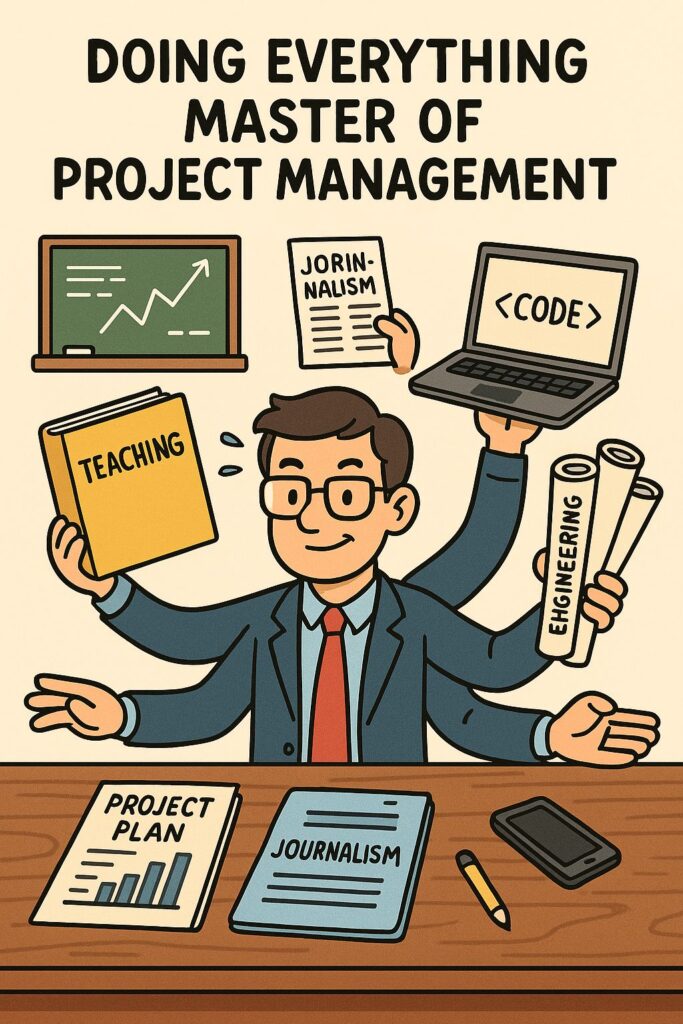
When I first stepped into the world of engineering as a fresh graduate, there was a phrase I heard often: “Doing everything makes you a master of nothing.” Back then, I was brimming with ambition. I wanted to learn IT, earn a master’s in food science, dabble in journalism, and somehow juggle all that while working fulltime as a site engineer on construction projects. I spent weekends teaching AutoCAD to make extra money.
I wasn’t exceptional in any of those areas, at least not yet. I had completed a four-year Engineering degree at the University of Peradeniya in Sri Lanka. The first two years were common to civil, mechanical, and electrical engineering. Specialization only kicked in during the final half of the program. This broad-based structure made us adaptable, yes—but it also meant we didn’t dive as deep as students from universities where specialization began earlier.
At first, that felt like a shortcoming. Graduates from those other programs entered the workforce well focused and hit the ground running in their chosen fields. Meanwhile, we, generalists landed jobs easily, but we weren’t seen as experts. Career growth and salaries reflected the same. It felt like that old saying was aimed squarely at us: jacks of all trades, masters of none.
But things began to shift.
As I gained experience, I started noticing a clear trend: in places like Sri Lanka, industries didn’t just want specialists; they needed engineers who could do a bit of everything. In contrast, more developed countries preferred people who stuck to their niche. That divide became obvious to me as I moved through various roles.
I remember working on the external cladding of what was then Sri Lanka’s tallest building, known locally as Pittu Bambuwa, the headquarters of a prominent public bank. Part of our contract involved bringing in foreign specialists for certain tasks. One such expert came from Australia to handle silicone sealing between claddings. He was brilliant, only at one task of sealing between claddings and tiles which are horizontally placed not verticals. . But when it came to sealing vertical joints between aluminium panels (a critical element in high-rise construction), he was completely out of his depth. We couldn’t wait, so we trained our local technicians to fill the gap while we sourced someone else. That incident stuck with me; deep expertise is useful, but without flexibility, it can become a bottleneck.
Another time, on a project in the Middle East, I met an engineer whose official title was Scaffolding Engineer. He knew scaffolding inside and out, especially the safety standards. But he couldn’t contribute beyond that. He didn’t understand scheduling, budgeting, or even basic project coordination. In a field where everything is interconnected, his role felt oddly isolated.
These moments helped me see a larger shift happening. Years ago, it was enough to be narrowly specialized. Not anymore. Today, what industries crave are T-shaped professionals, people who have depth in one discipline (the vertical bar of the “T”) but also breadth across others (the horizontal bar). It’s no longer just about being the best at one thing, it’s about understanding how your expertise fits into the bigger picture.
And it goes beyond work. Picking up a new language, exploring creative writing, or even watching a soap opera, these “non-technical” interests build emotional intelligence, creativity, and the ability to connect with others. Far from distractions, they shape how we lead and collaborate.
In Project Management especially, this mindset is gold. A good project manager doesn’t just crunch numbers or make timelines. They manage expectations, navigate culture, read the room, and bridge the gap between teams. They’re translators between specialists, making sure everyone’s rowing in the same direction.
Now, when I look back, all those so-called scattered pursuits. software, journalism, teaching, engineering all wasn’t random. They were puzzle pieces coming together.