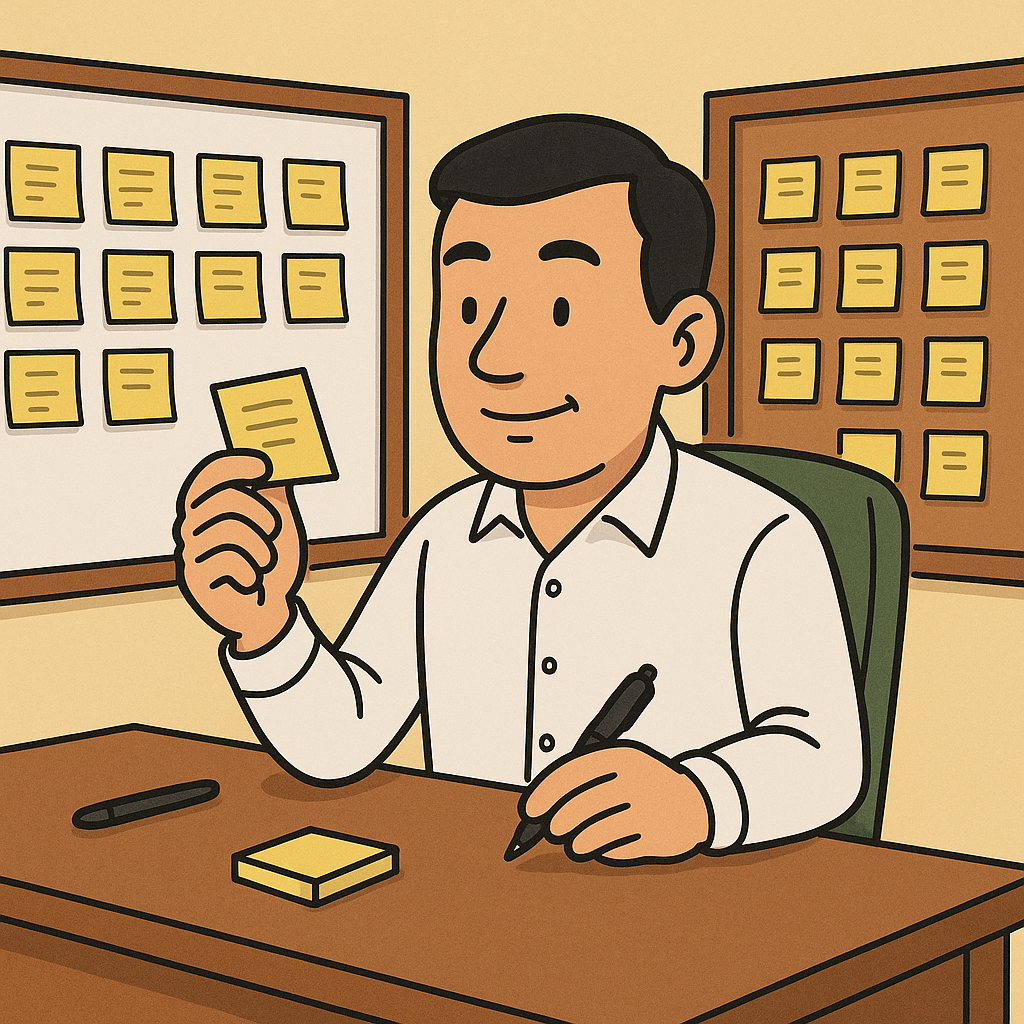
He picked up his sticky notepad and, for every task or issue discussed, he wrote two identical notes. One was handed directly to the person responsible. The other was pinned to his board. Simple, direct, and incredibly effective. After that, he would walk the team through the daily, weekly, and monthly plans, connecting them back to the project’s overall mission. It didn’t take long, but it always left the team focused and aligned.
He emphasized one point very clearly: fix the problems discussed and take action on the day’s tasks.
From 7:30 to 10:00 AM, he handled routine admin; reviewing letters, making calls, chatting with the team. He rarely did any deep writing or isolated work. Instead, he delegated responsibilities and guided from a high level, keeping track of things with his sticky notes.
What stood out was how relaxed he was. He didn’t rely on a laptop or smartphone for managing the project, those were mainly for leisure. At 10:00 AM, he’d head out for a thorough two-hour travel around the site, hands free,no phone, no notebook, just his presence and awareness.
When he got back, he took a shower, changed into fresh clothes, had his lunch, and even caught a short nap. By 2:30 PM, he was back at his board, scanning the sticky notes. If something had been completed or resolved, he’d pull the note off and toss it in the bin. If it was still in progress, he left it there or added new notes. By evening, most of the day’s tasks were done.
Any notes that remained would be part of the next morning’s briefing.
Interestingly, he didn’t keep personal logs or detailed records himself. That responsibility was assigned to planning engineers, competent, experienced professionals who knew what to document and how to report. He didn’t hover over them or stress them about details. He simply trusted his team to handle their roles.
He had a clear organizational structure. Sectional managers were in charge of their teams, and he didn’t micromanage. In fact, he didn’t even bother memorizing the names of staff below the managerial level. Still, he treated everyone with humility and respect.
His personal cabinet contained stacks of contract documents, and though he rarely needed to open them, when he did, he could flip to the exact page with surprising accuracy. He understood the contractual details but didn’t obsess over them.
Evenings were his time. Dinner was at 6:00 PM, followed by either a gym session or casual time with friends.
Looking back, I realize this project manager intuitively applied many of the principles we now associate with agile and Kanban project management. His sticky notes acted as the Kanban board. Morning briefings were stand-up meetings. He regularly conducted informal retrospectives and reviewed progress visually. He had a clear backlog, managed flow, and constantly reprioritized, all without digital tools or formal agile terminology.
In many ways, he was a hybrid manager ahead of his time, leading with clarity, simplicity, and emotional intelligence, long before some agile influences became common in the construction industry.