During a long-distance field trip, we had plenty of time to chat about wildlife. With me were our project’s biodiversity expert and a systems engineer of Malaysian nationality. The ways in which wildlife is protected in different countries, and the methods used to minimize human-wildlife conflicts, became topics of our conversation. They were also aware that wildlife conservation in Sri Lanka has once again become a subject of discussion due to the unfortunate recent death of the elephant Kavantissa.
I began the conversation by recalling an occasion some time ago when I visited Phillip Island in the State of Victoria, Australia.
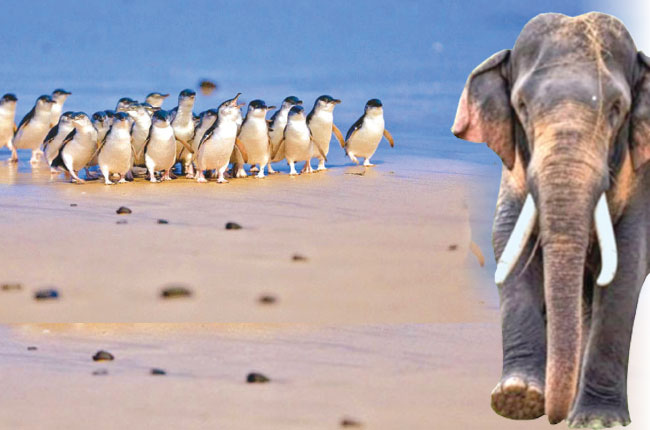
Phillip Island is world-famous for its resident little penguins. These birds, which spend all day searching for food in the ocean, come ashore as twilight falls and walk in small groups toward their nests. Thousands of tourists from various countries around the world arrive to witness this marvelous sight.
A notice board that I saw there is still in my memory. It displayed the expected time of the penguins’ arrival on the shore, as well as the number of birds that had arrived the previous day. I was amazed that the behavior of animals living in an environment not easily accessible to humans could be studied so systematically.
There is an even more wonderful aspect to this. I learned that an electronic chip as small as a grain of rice is implanted under the skin of penguins selected for research on Phillip Island. These chips, known as RFID, do not require a battery. Special electronic receivers installed along the paths where the birds travel identify them and automatically record their numbers and arrival times. Based on that information, the duration, frequency, and foraging patterns of their trips to search for food can be studied.
In some research programmes, chips are also fitted into chicks at an appropriate age before they head out to sea. Through this, their survival and behavior can be studied over several years.
There is another side to this as well. While Australia protects the penguins, it has also turned their natural behavior into an outstanding tourist experience. The revenue generated from tourists contributes to conservation, research, and the local economy. Leaving the penguins to live their lives, people come to observe those lives. On the other hand, a vital natural asset that attracts tourists to Sri Lanka is our elephants.
Hearing this story, the Malaysian engineer spoke about wild elephant conservation methods in her country. According to her, Malaysia’s wildlife department, known as PERHILITAN, uses GPS satellite collars to study the migration routes of elephants. When such a device is fitted to the matriarch leading a herd, important information regarding the movement patterns of the entire herd can be obtained. These also help in identifying risks around human settlements.
From there, the conversation turned back to the elephant Kavantissa in our country.
Kavantissa, one of the largest living elephants in Sri Lanka, died on October 16 while receiving treatment for injuries sustained from a gunshot. The demise of this majestic tuskers caused sorrow throughout the country as well as sparking a widespread discussion. Various details regarding the incident were reported, and accusations began to be leveled against various parties.
Following this incident, a question arose in my mind as to whether electronic chips could be fitted to elephants to locate where they are. However, it became clear during our conversation that the RFID chip of the penguins and the GPS collar worn by elephants are not the same thing. The former identifies the animal when it passes near a reading device. The latter allows the animal’s location to be known from a distance. The second method is much more useful when trying to locate an injured elephant.
This technology is not new to our country either. Sri Lankan researchers have been using GPS collars for years to study elephant movement patterns. I recently read in the news that programs using thermal cameras and sensors to identify elephants approaching railway tracks have also been initiated.
India uses Artificial Intelligence and fiber-optic sensors to detect elephants near railway lines. Researchers in Kenya attempt to identify elephant migration routes through satellite data and work to protect elephant corridors.
However, the true value of technology lies in connecting the gathered information together.
In which months do elephants enter a village? Is it during dry spells? During the harvesting season? Which paths do they travel along? If years of data are compared with rainfall, cropping patterns, and forest cover, and analysed using Artificial Intelligence, the locations and times where conflicts are likely to occur could be identified in advance.
Then, rather than chasing elephants away after they enter a village, villagers could be warned before they arrive, and wildlife officers could prepare. Scientific data could also be utilised when planning settlements, farmland, electric fences, and elephant corridors.
What we need is not merely buying more and more equipment, but building a national wildlife information system by bringing together the Department of Wildlife Conservation, universities, research institutions, and IT experts. It must be useful to wildlife officers as well as villagers.
On the other hand, it occurs to me that restricting all elephants to a few forests will not be a solution. They have traditional migration routes, and when these are blocked, conflicts arise. At the same time, we cannot ignore the villages and farmland located in areas frequented by elephants, nor the livelihoods and safety of the people living there. Technology and knowledge should be used not to trap elephants or cause further distress to people, but to design an environment where both sides can live safely.
The penguins of Phillip Island return to their nests every evening. They do not do so to entertain tourists; they do it to live their natural lives. Yet, humans who understood that life have protected it while creating a wonderful experience for the world.
Could not the story of our elephants be the same?
In an era when the world is using Artificial Intelligence to predict the future, should we still be pondering what to do only after an elephant enters a village, or wondering where in the wild the country’s largest tusker is wandering after being shot?
Neither information technology nor Artificial Intelligence can feel the pain of a shot elephant or a farmer suffering because of elephants. However, these technologies can be utilised to identify hazards before that pain occurs and to plan measures to prevent them.