In large infrastructure projects, we often discuss progress in terms of percentages. We have a set of typical KPIs. Concrete poured. Cables laid. Variations approved. We measure everything carefully and report upward with confidence. Yet sometimes the real tension inside a project does not come from a delayed drawing or a disputed variation. It comes from something much smaller.
In the Middle East , during one of my assignments, the consultant compound had a modest but comfortable covered parking area. For years, people parked more or less according to habit. No one paid much attention to hierarchy when it came to shade from the sun. But there was an issue due to the limitation of covered car parks.
One day, after considering a number of facts a new rule was introduced. The covered parking inside the compound would be reserved strictly for Managers , Visitors of the Project Manager and Senior Engineers. All others were to park outside the gate in a partially covered area.
On paper, it sounded reasonable. Many hierarchical organisations ran on such classifications. Structure gives clarity. Titles create order.
But projects are not managed on paper alone.
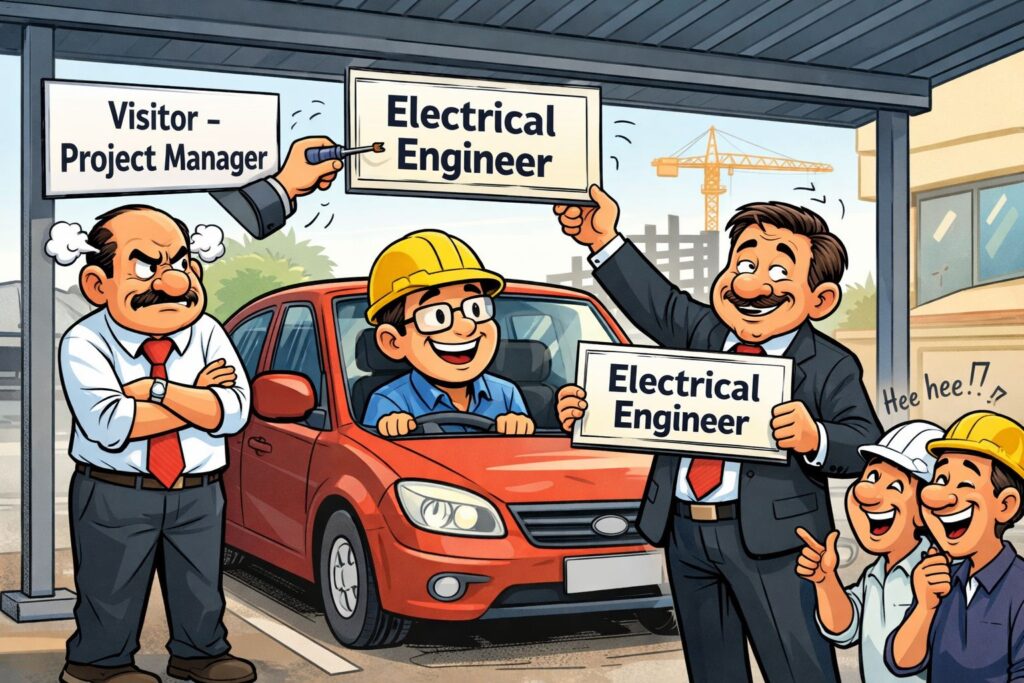
One Electrical Engineer, who had quietly served the project for years and had been parking inside the compound without incident, did not accept the change easily. He did not shout or protest in a formal meeting. Instead, he simply drove inside as usual and parked his vehicle in one of the two covered spaces marked “Visitor – Project Manager.”
The Admin Manager confronted him. The engineer argued back. The discussion repeated itself the next day. And the next.It became a well known conflict of the project.
It was not really about parking. Everyone knew that. There were plenty of spaces outside. But inside that small argument lay something deeper related to pride, recognition, a sense of belonging.
Emails began to circulate. Voices rose occasionally. The technical work continued, but a thin layer of discomfort settled over the team. It is interesting how quickly the atmosphere can change. A project may appear healthy in reports while irritation quietly spreads in corridors. This conflict may be a silent blocker for collaboration and progress.
Eventually, the Project Manager decided to step in.
There was no dramatic meeting. No official memo. No formal warning. The next morning, the compound looked exactly the same , except for one detail.
The signboard that had read “Visitor – Project Manager” was gone.
In its place was a new board: “Electrical Engineer.”
Nothing else changed.
The engineer parked calmly in the shaded space. His face seemed a little guilty but with a smile. The Admin Manager said nothing. The team noticed. Some smiled. A few laughed softly. And just like that, the tension dissolved. It might not be the best solution in the administrative point of view.
It was such a simple act that at first it seemed almost humorous. But the more I reflected on it, the more I realised it’s quiet intelligence.
The conflict had never been about proximity to the office or protection of the car from the sun. It had been about recognition. The Admin Manager was protecting a rule. The Electrical Engineer was protecting his dignity.
The Project Manager did not dismantle authority or embarrass anyone. He did not rewrite the policy or escalate the matter. He shifted the meaning of the space. With one small gesture, he acknowledged the engineer’s identity without weakening organisational structure.
That day, I understood something that no scheduling software could teach me. Leadership is not always about asserting control. Sometimes it is about reading what lies beneath the argument.
The cost of replacing that signboard was insignificant. The gain in harmony was immediat
Interestingly, after this quiet yet creative solution, no one else objected to the arrangement, and the other staff members who continued to park outside the gate never demanded space inside.
Years later, I still remember that parking space more clearly than many formal meetings. Perhaps because it reminded me that while budgets and schedules move projects forward, culture sustains them.
And sometimes, culture changes not with policy ; but with a signboard.