Artificial Intelligence is entering almost every professional field, and project management is no exception. Many discussions around AI begin Projects rarely fail because teams lack enough templates. They fail because the early thinking is weak. The scope is unclear, assumptions are not tested, stakeholders expect different things, and the schedule is built on hope rather than evidence. This is why planning remains one of the most important stages of project management.
Generative AI can be useful here, not because it can plan a project on its own, but because it can help project managers think through the planning process systematically. Used well, it can act as a planning assistant that helps draft, question, organise, and refine. Used carelessly, it can produce documents that look complete while hiding serious gaps.
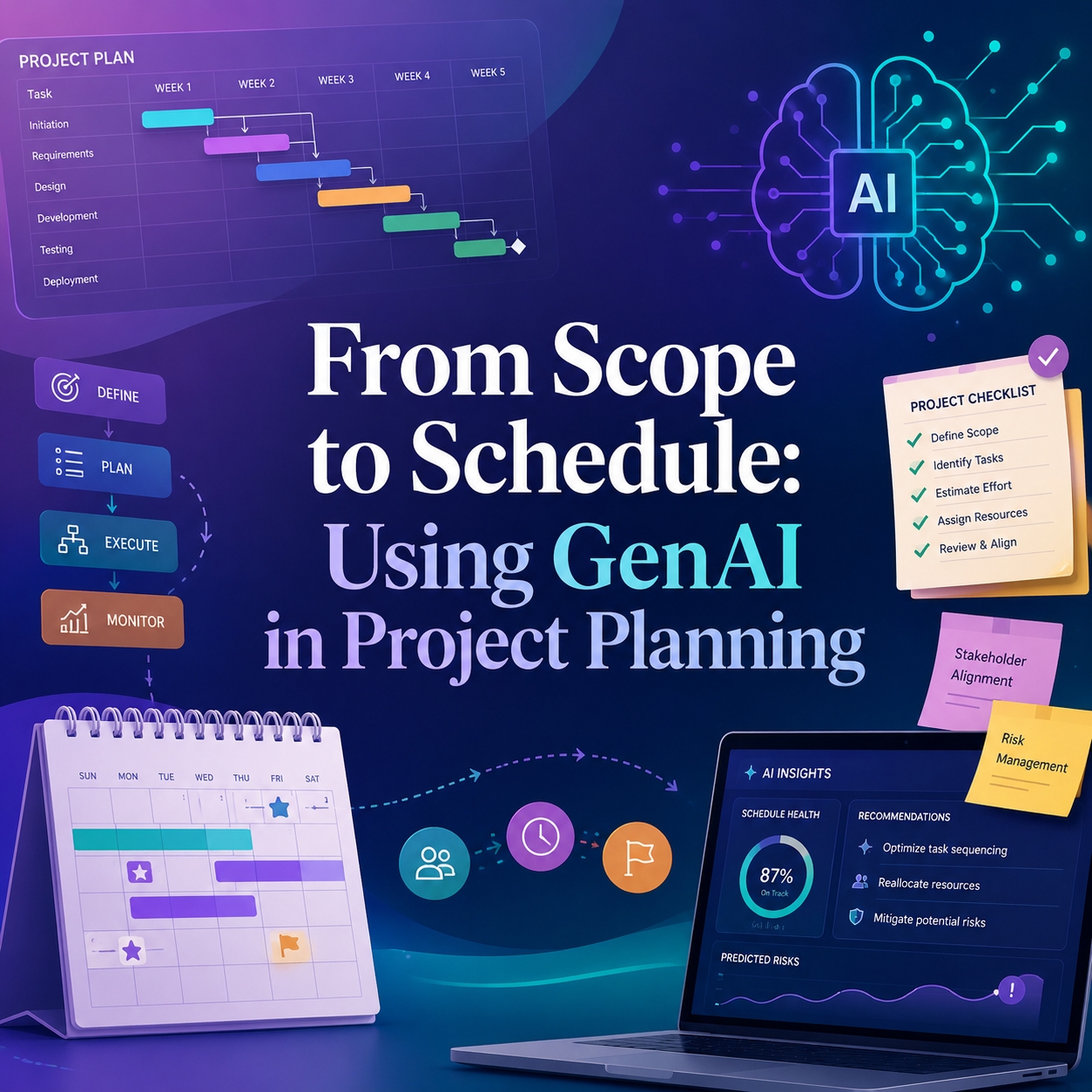
The starting point is scope. A project manager can use GenAI to turn rough notes, meeting discussions, or a concept brief into a first draft of a project charter or scope statement. It can help identify possible objectives, deliverables, exclusions, constraints, dependencies, and success criteria. This is helpful because many projects begin with scattered information. AI can quickly bring structure to that information.
But this first draft must not be mistaken for agreement. Scope is not just a written statement. It is a shared understanding among the people who matter. AI may help draft the words, but the project manager must still check whether the sponsor, client, users, technical team, and delivery team understand the scope in the same way. That validation is human work.
GenAI can also help expose assumptions. Every project plan carries assumptions, even when they are not written down. We assume resources will be available, approvals will come on time, suppliers will deliver, users will cooperate, data will be accessible, and technology will behave as expected. A useful prompt for AI is not only “Help me plan this project” but also “What assumptions am I making, and which could be risky?” This can help project teams see weak points early.
The next area is work breakdown. Once the scope is clear, GenAI can help suggest a work breakdown structure, activity list, milestones, and dependencies. It can help project managers break down a broad objective into smaller pieces of work. This is useful in early planning workshops, where teams need a starting structure for discussion.
Again, the output is only a starting point. AI may suggest irrelevant tasks, overlook activities specific to the organisation, or underestimate the complexity of approvals, procurement, testing, integration, or training. The project team must review the structure carefully. The value of AI is not that it gives the final answer. Its value is that it gives the team something to challenge, improve, and adapt.
Scheduling is another area where GenAI can support thinking, though with clear limits. It can help create schedule narratives, identify logical sequences, suggest milestone groupings, and highlight possible bottlenecks. It can also help explain schedule options to different audiences. For example, the same schedule issue may need to be explained differently to senior management, a technical team, and an external partner.
However, GenAI cannot assess a team’s true productivity unless the right data is available. It cannot know internal approval delays, hidden dependencies, individual workloads, or organisational politics. A schedule produced by AI should be treated with caution. It may look neat, but neatness is not the same as realism.
AI is particularly useful for asking better planning questions. What could delay this project? Which stakeholders need to be consulted before the scope is finalised? What deliverables are missing? What dependencies are not visible? What risks arise if one milestone moves? What should be clarified before the project is approved? These questions can improve the quality of the planning conversation.
For project managers, the practical lesson is simple. Use GenAI to reduce the blank-page problem, to organise early thinking, and to test whether the plan is complete. But do not outsource judgment. Planning is not just document production. It is negotiation, clarification, prioritisation, and alignment.
In the age of AI, good project planning will depend on disciplined project managers. The tools may help us draft faster and think wider, but people must still decide what is realistic, what is important, and what the project is meant to deliver.