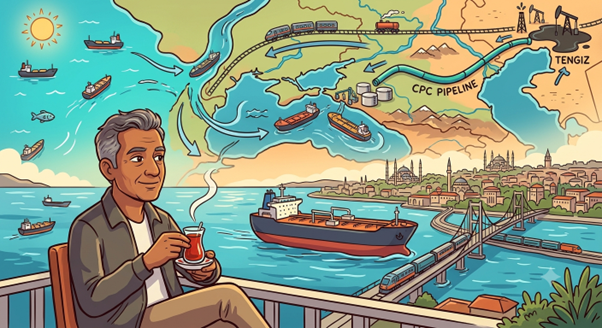
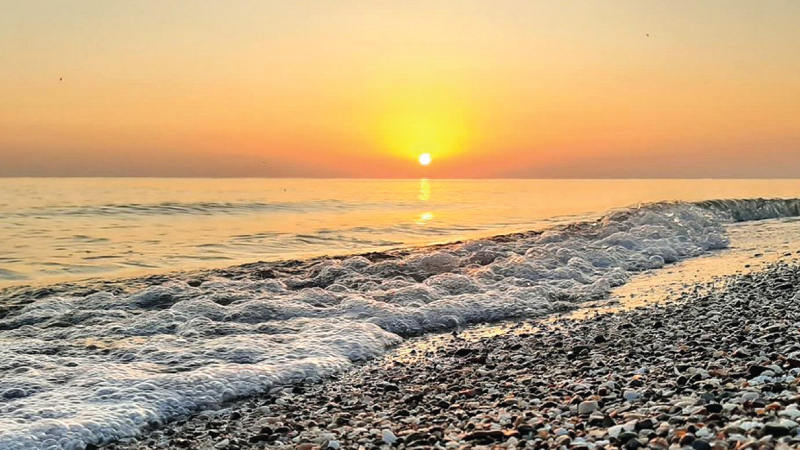
We were sitting at our usual spot along the Bosphorus last weekend, tulip shaped glasses of tea warming our hands, when a massive oil tanker drifted slowly across the horizon. I pointed to it and told my colleagues: that ship might be carrying oil from Tengiz the vast field on Kazakhstan’s Caspian shore where I worked as a planning engineer from 2007. A distant freight train echoed across the water. That too, I said, could be hauling machinery bound for those same oil fields, three thousand kilometres away.
My friends went quiet, looking out at the strait. Nearly two decades on, standing here in Istanbul gives me a perspective I couldn’t have had back then, a macro-level view of work I once saw only through the narrow lens of master schedules, critical paths, and risk registers. The connection is now undeniable: there is a direct, if invisible, thread between the crude oil beneath the Kazakh steppe and the maritime artery running beneath my feet.
In the oil and gas world, laymen assume the primary challenge is getting the oil out of the ground. Any seasoned project professional knows the true complexity begins after that. The real value of a commodity is determined by a logistics masterclass: whether you can transport it safely, continuously, and cost effectively to the global market. For Kazakhstan’s landlocked resources, solving that problem required one of the most ambitious infrastructure projects ever conceived.
The Caspian Pipeline Consortium the CPC is a business collaboration in international stakeholder management. Spanning Kazakhstan and Russia, and binding together an alliance of global energy giants including Chevron of US, KazMunayGas of Kazakhstan, and Lukoil of Russia, this 1,500 kilometre pipeline begins in the Caspian lowlands, cuts through Russia’s Astrakhan region, the Kalmyk Republic, and the Krasnodar Krai, and terminates at the Port of Novorossiysk on the Black Sea. Without this global joint venture managing an immense web of conflicting stakeholder expectations and compliance frameworks the project would be an impossibility for any single entity.
From Novorossiysk, tankers cross the Black Sea, funnel through the narrow bottleneck of the Bosphorus, and break out into the Mediterranean to feed global markets.
Tengiz Field | → | CPC Pipeline | → | Novorossiysk Port |
| | | | | ↓ |
Mediterranean Market | ← | Bosphorus Strait | ← | Black Sea |
This brings me to a paradox that every project manager should sit with. As a Sri Lankan engineer, I cannot help but note a striking coincidence of acronyms. The Caspian Pipeline Consortium ;CPC operates across 1,500 kilometres of unforgiving terrain, through winters of −30°C and desert summers of 40°C, managing vast throughput via automated SCADA systems and elaborate risk-mitigation infrastructure. The Ceylon Petroleum Corporation back home sharing the exact same initials has spent decades navigating feasibility studies, bureaucratic loops, and political shifts to modernise a few kilometres of critical fuel pipelines between the Colombo Port and Kolonnawa.
The lesson is fundamental: project complexity is not proportional to physical scale. A short pipeline modification in a densely populated urban centre can face greater systemic density than one stretching halfway across a continent. True complexity is driven by right-of-way disputes, land acquisition gridlocks, environmental red tape, shifting political priorities, and stakeholder friction and not by kilometres.
The interconnectedness does not stop with oil flowing west. The equipment flowing into mega-projects like Tengiz relies on the emerging Middle Corridor , the Trans-Caspian International Transport Route. Container trains from China cross the Kazakh steppe to the Caspian, ferry across to Azerbaijan, and travel by rail through Georgia and Türkiye into Europe. The train echoing across the Bosphorus is not merely local transit. It is a dependency node in a global supply chain keeping projects alive thousands of miles away.
Watching those tankers navigate the strait that evening, something became clear. The world is not a collection of isolated nations or standalone projects. It is a single, living network bound together by pipelines, railways, ports, and most importantly human collaboration thus validates the project management principle ‘System Thinking ‘. At one end of this particular network sits Tengiz. At the other, Mediterranean sea. What flows between them is much more than crude oil: it is engineering intellect, capital, diplomacy, and the kind of rigorous project management that most people will never see or think about.
Life itself, in the end, is a project of building connections. The grander the vision, the more dependencies you must manage. But when the integration is seamless, the results move the world.