Projects are delivered through people. Plans, schedules, budgets, dashboards, and reports are important, but none of them delivers a project by themselves. People make commitments, raise concerns, negotiate priorities, share information, delay decisions, resist change, and sometimes quietly disengage. This is why stakeholder communication and leadership remain central to project management.
In the age of AI, it is easy to focus on tools. We can ask AI to draft emails, summarise meetings, prepare presentations, write reports, create stakeholder maps, and suggest communication plans. These are useful capabilities. They can save time and help project managers communicate more clearly. But communication is not only about producing better words. It is about understanding people, context, timing, trust, and consequence.
A project manager may use GenAI to prepare a message for senior management, a client, a technical team, or end users. The tool can adjust tone, simplify language, and organise the message. This can be helpful, especially when the same project issue must be explained differently to different audiences. A delay, for example, may require a factual explanation to management, a technical discussion with the team, and a careful reassurance to the client.
But AI does not know the history of the relationship. It may not be known that one stakeholder is already frustrated, that another feels ignored, or that a particular word may create unnecessary tension. It cannot sense the mood in a meeting or understand the politics behind silence. These are human signals, and good project managers pay attention to them.
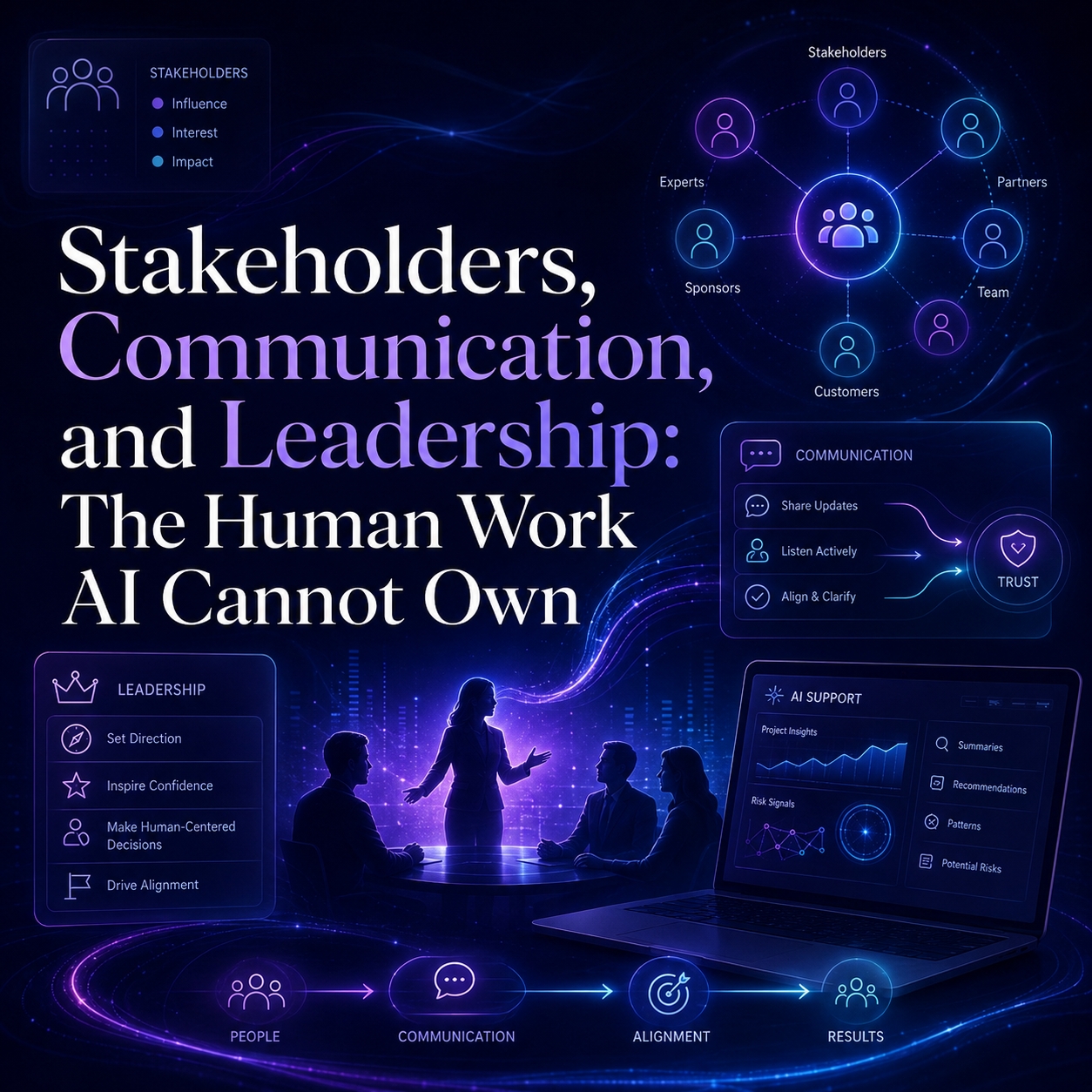
Stakeholder management is not just identifying names in a matrix. It is about understanding influence, expectations, fears, incentives, and levels of commitment. AI can help draft a stakeholder analysis, but the project manager must interpret it. Who really supports the project? Who is uncertain? Who can block progress? Who needs to be consulted early? Who feels ownership, and who feels the project is being imposed on them?
This matters because many project problems are not technical. They are social. Requirements changed because stakeholders were not aligned. Decisions are delayed because ownership is unclear. Teams lose motivation because communication is poor. Users resist adoption because they were not properly engaged. In such situations, AI may help describe the problem, but leadership is needed to resolve it.
One useful role for AI is preparation. Before an important discussion, a project manager can use AI to consider potential stakeholder concerns, prepare talking points, anticipate objections, and clarify the decision required. This can improve the quality of the conversation. It can also help less-experienced project managers communicate with greater structure and confidence.
However, the actual conversation still belongs to people. Trust is not built by a well-written message alone. It is built through consistency, listening, honesty, follow-up, and fairness. A project manager who uses AI to communicate faster but does not listen better will not become a better leader.
Leadership in projects also involves judgment under pressure. When the schedule is slipping, when a team is tired, when a client is unhappy, or when priorities conflict, the project manager must decide how to respond. AI may suggest options, but it cannot carry the emotional and professional responsibility of the decision.
There is also a risk of over-polished communication. AI-generated messages can sound balanced, confident, and complete, even when the project situation is messy. If the message hides uncertainty or avoids difficult truths, it can damage trust. Project communication should be clear and honest.
The future project manager will therefore need both AI literacy and human sensitivity. They must know how to use tools, but also when not to use them. They must know how to write faster, but also how to listen better. They must know how to generate options and how to build agreement.
AI can support stakeholder communication. It can help structure messages, prepare discussions, and reduce routine writing. But it cannot own relationships. It cannot earn trust. It cannot lead a team through uncertainty.
That remains human work. And as AI takes over more routine tasks, human work may become even more important. Project managers should remember this: better tools can improve communication, but only better leadership can turn communication into sustained project commitment.